conifer dentist near me, bailey co dentist near me, best dentist near me, family dentist

Conifer Dental Group

J. Douglas Wilson DDS, PC

10801 Kitty Drive

Conifer, CO 80433 US

(303) 838-7904

Request An Appointment
Menu
  • Home
  • About Us
    • Meet the Doctor
    • Meet Our Assistants
    • Meet Our Hygienists
    • Meet Our Front Desk
  • Contact Us
  • Our Practice
  • Our Services
    • Dental Hygiene
    • Cosmetic Services
      • Veneers
      • Whitening
      • Bonding
    • Restorative
      • Bridges
      • Crowns
      • Dentures
      • Bonding
    • Periodontic
      • Arestin
      • Periodontal Splinting
      • Periodontal (gum) Disease
      • Periodontal Therapy
    • TMJ
    • Night Guards
    • Occlusal Adjustment
  • Our Technology
    • Digital X Ray
    • Intraoral Camera
    • Electric Handpieces
    • Nitrous Oxide
    • Oral Cancer Screenings
    • Panorex
  • Patient Resources
    • New Patient Packet
    • Child Registration Form
    • Emergency Notification
    • Privacy Policy Form
    • Release Forms
    • Links
    • Post-Op Instructions
    • Q & A
  • Testimonials
  • Financial Info
  • Newsletter
  • Blog


Now accepting New Patients

  • Home >
  • Articles >
  • Periodontal Therapy >
  • Gum Grafting

Gum Grafting

  • Created in Periodontal Therapy

If your dentist has detected that your gums have receded substantially, you may be referred to a periodontist for a gum graft. Gum recession occurs when the tissue surrounding each tooth pulls away, exposing more of the tooth or the tooth root. This exposure can cause significant damage to the supporting bone, in addition to causing tooth sensitivity. Gum recession happens over time, so you may not notice when it’s happening. If left untreated, gum recession will result in tooth loss. Gum grafting repairs this damage before it gets even worse.

Types of Gum Grafts
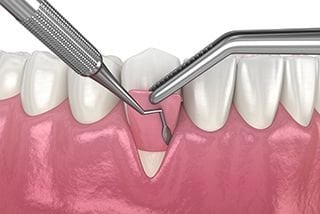
gum graftDepending on your mouth’s unique needs, your periodontist will choose one of the following types of gum grafts:

  • Connective Tissue: The most common type of graft to treat root exposure is a connective tissue graft. In the roof of your mouth, a flap of skin is cut and pulled back. Tissue underneath this flap, known as subepithelial connective tissue, is then removed and stitched to surround the exposed tooth root. Once this is finished, the flap in the roof of your mouth is also stitched down.
  • Free Gingival: A free gingival graft is similar to the connective-tissue graft because it also uses tissue from the roof of the mouth. However, instead of creating a flap, tissue is directly removed from the roof of the mouth. This tissue is then attached to the area of the gums that is being treated. This graft is most often used for people who have thin gums.
  • Pedicle: For a pedicle graft, tissue is taken from the gums near the tooth needing repair. The flap, known as a pedicle, is partially cut away so that one edge stays attached. The gum is stretched over to cover the exposed root and is then sewn in place. This graft can only be performed on people who have enough gum tissue near the affected tooth.
  • Tissue Bank: There are some patients and periodontists who prefer to use graft material from a tissue bank instead of the patient’s own mouth. Tissue-stimulating proteins are added to encourage the body’s natural ability to grow bone and tissue.
  • Educational Videos
  • Cosmetic & General Dentistry
  • Emergency Care
  • Endodontics
  • Implant Dentistry
  • Oral Health
  • Oral Hygiene
  • Oral Surgery
  • Orthodontics
  • Pediatric Dentistry
  • Periodontal Therapy
  • Technology

Featured Services

Click to find out more

  • Dental Hygiene

    While at our office, we make sure that you receive the highest level of service and ensure that our dental work is of the highest quality.

    Read More
  • Teeth Whitening

    Whitening procedures have effectively restored the smile of people with stained, dull, or discolored teeth.
    Read More
  • Veneers

    Veneers are an excellent way to redesign and reshape your entire mouth. Veneers are a very thin ceramic shell that covers your existing tooth structure.

    Read More
  • TMJ Support

    Some of the symptoms of TMD are pain when opening or closing mouth, trouble chewing, jaw becoming stuck open or shut, headaches or ear pain, clicking or popping sounds when opening your mouth, teeth grinding and more.

    Read More

Office Hours

We look forward to hearing from you.

Monday:

8:00 am-5:00 pm

Tuesday:

8:00 am-5:00 pm

Wednesday:

8:00 am-5:00 pm

Thursday:

8:00 am-5:00 pm

Friday:

Closed

Saturday:

Closed

Sunday:

Closed

CONNECT WITH US

Easy Access

Located across the street from Staples. Parking in front and back.

  • Copyright © 2026 MH Sub I, LLC dba Officite.
  • Admin Log In
  • Site Map